PCI Card Project Episode 1: ARIES Board Project Design
1. Introduction
Since I had ideas to connect various peripherals to an FPGA, designing and fabricating a new FPGA board every single time seemed like an unnecessary waste of time. Therefore, this project was born.
- Connect with an external FPGA
- Connect a CPU or microcontroller to expand ports
But in the end, it turned out that using the FPGA as a microcontroller itself was the best approach.
For the CPU to connect, I initially thought of using TI's OMAP. However, because it was too complicated to handle BGA routing, high-speed signal routing, etc., I ultimately decided to use a soft-core CPU inside the FPGA instead.
2. Origin of the Name ARIES Board
This board is designed to support 2 modes of operation:
- PCI card
- Stand-alone (without using PCI card) using NIOS II soft-core
And in the future, it might be developed further into PCI Express.
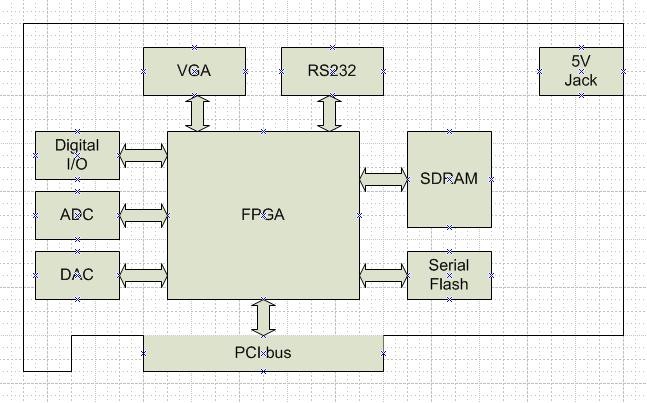
3. ARIES Board Specifications
- Analog input output
- Digital input output
- Switch input
- VGA (Shared with LED)
- RS232
The Analog I/O and Digital I/O sections are connected directly to the FPGA for high-speed operation.
FPGA: Altera Cyclone II 5000LE
- DIO 16Channel
- ADC 12bit
- DAC 12bit
- SDRAM 256MBit
- Serial flash 4MBit
4. Conclusion
This project will focus mainly on the board design. The details of VHDL/Verilog programming will not be covered in depth just yet.